
Fairdeal Responsible Play Tips for Beginners : A Complete Guide to Safer and Smarter Gaming
Online gaming can be an enjoyable form of entertainment when it is approached with awareness, balance, and self-control. For beginners, one of the most important things to understand is that responsible play should always come before excitement, bonuses, or the possibility of winning.
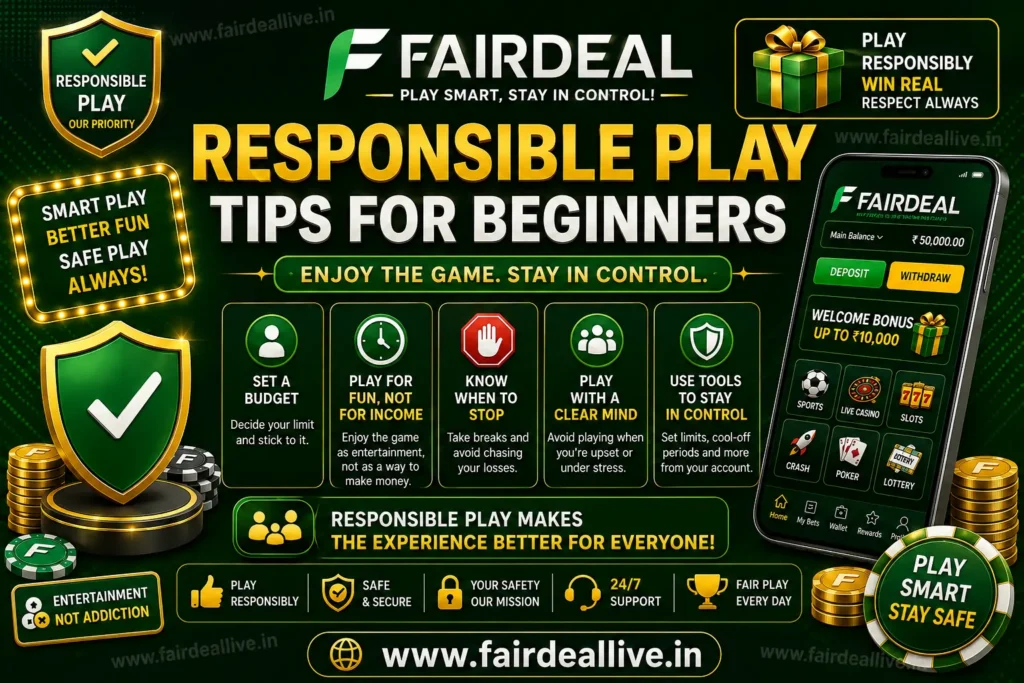
This guide explains practical Fairdeal Responsible Play Tips for Beginners and focuses on healthy habits such as setting budgets, managing time, avoiding emotional decisions, recognizing warning signs, and taking breaks when necessary. Fairdeal’s published responsible gaming guidance emphasizes that gaming should remain entertainment rather than a source of financial stress or income.
What Does Responsible Play Mean Fairdeal?
Responsible play means making informed decisions about how much time, money, and attention you give to gaming activities. It means understanding that outcomes are uncertain and that no result can be guaranteed.
A responsible approach includes:
- Playing only if you are legally eligible
- Following applicable local laws
- Treating gaming as entertainment
- Setting a personal spending budget
- Managing session time
- Taking regular breaks
- Avoiding attempts to recover losses
- Never using essential money
- Recognizing when gaming is becoming stressful
- Using available account-control tools when needed
Fairdeal’s responsible gaming information describes tools such as session limits, deposit limits, reality checks, cooling-off periods, and self-exclusion options to help users maintain control.
For beginners, the goal should never be to play as much as possible. The goal should be to understand your personal limits and make decisions that protect your financial and personal well-being.
1. Treat Gaming as Entertainment, Not as a Source of Income
One of the most important responsible play tips is to maintain realistic expectations.
Gaming should be viewed as a form of entertainment, similar to spending money on other leisure activities. It should not be treated as:
- A guaranteed income source
- A business investment
- A solution to financial problems
- A method for paying bills
- A way to recover previous losses
Outcomes can be unpredictable. Winning is never guaranteed, and losses are always possible.
When users start believing that gaming is a dependable way to make money, they may begin making decisions based on pressure rather than enjoyment. This can lead to spending more than planned or continuing to play after reaching a personal limit.
A healthier mindset is simple: decide in advance what amount you are comfortable spending for entertainment, and accept that amount as part of your entertainment budget.
2. Set a Clear Budget Before You Start Fairdeal
A personal budget is one of the strongest tools for responsible play.
Before starting any gaming session, decide exactly how much money you can comfortably afford to spend without affecting your:
- Rent
- Food
- Education
- Medical needs
- Family responsibilities
- Loan payments
- Savings
- Emergency funds
- Daily living expenses
Only consider entertainment money that you can genuinely afford to lose.
For example, instead of deciding your budget while playing, decide it before logging in. Once you have reached the amount you planned to spend, stop for the day or session.
Fairdeal’s published responsible gaming guidance refers to deposit limits as a way for users to manage spending and stay within a personal budget.
A Simple Budget Rule for Beginners
Before playing, ask yourself:
“If I lose this amount completely, will it create a financial problem for me?”
If the answer is yes, do not use that money.
Responsible gaming starts with protecting your essential financial needs.
3. Never Chase Losses Fairdeal
Chasing losses is one of the most common mistakes beginners can make.
It happens when someone loses money and immediately continues playing because they believe the next result will recover the previous loss.
For example:
“I have already lost money, so I need to continue until I get it back.”
This mindset can become risky because previous losses do not guarantee a future win.
Every new decision should be treated independently. Increasing spending because of a previous loss can make financial problems worse.
Instead, create a clear stopping rule before you begin.
Your rule could be:
- Stop after reaching your planned spending limit
- Stop when your entertainment budget is finished
- Take a break after a losing session
- Never increase your budget just to recover money
Fairdeal’s responsible gaming guidance specifically advises users not to chase losses and to remember that gaming outcomes involve chance and uncertainty.
Fairdeal Responsible Play Tips for Beginners
Table of Contents
4. Set a Time Limit for Every Session
Responsible play is not only about money. Time management is equally important.
Long gaming sessions can make it easier to lose track of:
- How long you have been playing
- How much money you have spent
- Your emotional state
- Other responsibilities
Before starting, decide how much time you want to spend.
For example:
- 20 minutes
- 30 minutes
- One hour
When your planned session ends, take a break.
Fairdeal’s responsible gaming information describes session time limits and reality-check reminders designed to help users monitor the time they spend gaming.
Helpful Time Management Habits
You can improve control by:
- Setting an alarm on your phone
- Taking breaks between sessions
- Avoiding late-night sessions when tired
- Planning other activities during the day
- Not allowing gaming to interrupt work or family responsibilities
Gaming should fit around your life, not replace important parts of it.
5. Avoid Playing When You Feel Emotional
Emotions can strongly influence decision-making.
Avoid gaming when you are feeling:
- Angry
- Stressed
- Depressed
- Extremely excited
- Frustrated
- Lonely
- Under pressure
- Tired
Strong emotions can make it harder to follow your personal budget and stopping rules.
For example, an angry person may make impulsive decisions. Someone experiencing financial stress may start viewing gaming as a solution to money problems.
Neither situation supports responsible decision-making.
Fairdeal’s responsible gaming guidance recommends avoiding gaming when upset or under the influence because emotions and impaired judgment can make rational decisions more difficult.
If you notice that your mood is affecting your decisions, the best choice may be to step away and return to another activity.
6. Take Regular Breaks
Taking a break is not a failure. It is a responsible habit.
A short break can help you:
- Review your spending
- Check your emotional state
- Think clearly
- Spend time with family
- Focus on work or hobbies
- Decide whether you still want to continue
You do not need to wait until gaming becomes a serious problem before taking a break.
Fairdeal describes cooling-off and temporary suspension options that can help users step away from gaming for a chosen period.
A break can be especially useful if you notice that you are:
- Playing longer than planned
- Spending more than planned
- Thinking constantly about gaming
- Feeling stressed about previous results
- Ignoring other responsibilities
7. Use Deposit and Spending Limits
Limits can help beginners create a clear boundary before emotions become involved.
Depending on the tools available in your account, responsible gaming features may allow users to set limits related to deposits, losses, or session activity. Fairdeal’s published policies describe deposit limits and other account-control options for managing gaming behavior.
The advantage of setting a limit in advance is that the decision is made while you are thinking clearly.
A good beginner approach is:
- Decide your entertainment budget.
- Choose a realistic limit.
- Set the limit before playing.
- Do not increase the limit emotionally.
- Review your spending regularly.
Remember that a responsible limit should protect your essential financial needs.
8. Keep Track of Your Activity
Many beginners do not realize how much they have spent or how much time they have used until after a long session.
Keeping track can improve awareness.
Review:
- Deposits
- Withdrawals
- Time spent
- Frequency of sessions
- Overall spending
- Changes in your behavior
You can maintain a simple personal record if necessary.
For example:
Date: Monday
Planned budget: ₹500
Time limit: 30 minutes
Actual time: 30 minutes
Stopped as planned: Yes
The purpose is not to create complicated records. It is simply to understand your habits.
If you notice that your spending or playing time is increasing regularly, take that as a signal to review your limits.
9. Do Not Borrow Money to Play
Never borrow money for gaming.
Avoid using:
- Loans
- Credit intended for essential expenses
- Borrowed money from friends
- Borrowed money from family
- Rent money
- Tuition money
- Emergency savings
Responsible gaming means using only money that you can comfortably allocate to entertainment.
If you feel that you need to borrow money to continue playing, that is a strong sign that you should stop and reassess your situation.
Gaming should never create debt or financial pressure.
10. Keep Gaming Separate From Essential Responsibilities
Your responsibilities should always come first.
Do not allow gaming to interfere with:
- Work
- Studies
- Family time
- Sleep
- Exercise
- Personal relationships
- Financial responsibilities
A balanced lifestyle includes many activities beyond gaming.
Spend time on hobbies, fitness, learning, family, and social activities. Fairdeal’s responsible gaming guidance also encourages players to balance gaming with other parts of life and maintain a healthy routine.
If gaming begins replacing important responsibilities, it may be time to take a break.
11. Learn to Recognize Warning Signs
Responsible play includes knowing when something may be going wrong.
Some warning signs can include:
- Spending more money than intended
- Playing longer than planned
- Trying repeatedly to recover losses
- Hiding gaming activity from others
- Feeling guilty after playing
- Thinking about gaming constantly
- Ignoring work or family responsibilities
- Borrowing money to continue
- Feeling anxious when unable to play
Fairdeal’s responsible gaming information lists similar warning signs, including excessive spending or time, chasing losses, hiding activity, emotional distress, and neglecting responsibilities.
Recognizing these signs early can make it easier to take positive action.
12. Talk to Someone You Trust
If gaming is causing stress, financial pressure, or relationship problems, do not keep everything private.
Consider talking to:
- A trusted family member
- A close friend
- A financial adviser
- A qualified counselor
- A professional support organization
Talking about a problem can make it easier to understand the situation and take practical steps.
If you feel unable to control your gaming activity, professional support may be helpful.
Fairdeal’s responsible gaming page also points users toward independent support resources such as Gamblers Anonymous, Gambling Therapy, and BeGambleAware for people seeking help.
13. Consider Self-Exclusion When Needed
Self-exclusion is a stronger responsible gaming tool for people who believe they need a longer or more structured break.
Depending on the platform’s available procedures, users may be able to request temporary or longer-term restrictions on account access.
Fairdeal’s published responsible gaming information describes self-exclusion as an option for users who want to pause or restrict access to gaming activities.
Consider this option if:
- You repeatedly exceed your own limits
- You cannot stop when you planned to stop
- Gaming is causing financial problems
- Gaming is affecting relationships
- You feel stressed or distressed about your activity
Taking a break can be a positive and responsible decision.
14. Protect Your Account and Payment Information
Responsible play also includes digital security.
Keep your account secure by:
- Using a strong password
- Not sharing login details
- Keeping OTPs private
- Never sharing your UPI PIN
- Avoiding suspicious links
- Logging out of shared devices
- Using official account pages
- Monitoring account activity
Fairdeal’s rules emphasize keeping account credentials confidential and reporting suspected unauthorized access to support.
Do not trust messages from unknown individuals who ask for:
- Passwords
- OTPs
- Card details
- UPI PINs
- Account access
Protecting your account helps you maintain control over your activity.
15. Only Play If You Meet the Legal Age and Local Requirements
Responsible gaming begins with eligibility.
Fairdeal’s published rules and responsible gaming policies state that users must be at least 18 years old and must comply with applicable laws and regional restrictions.
Before participating in any online gaming activity, users should ensure that:
- They meet the legal age requirement
- Participation is permitted where they live
- They understand applicable laws
- They follow relevant platform rules
Never attempt to bypass age or geographic restrictions.
A Simple Responsible Play Routine for Beginners
If you are new to Fairdeal or online gaming in general, consider following this simple routine.
Before Playing
Ask yourself:
- Am I legally eligible?
- Is gaming permitted in my location?
- Am I feeling calm and clear-headed?
- What is my entertainment budget?
- How much time will I spend?
- What is my stopping point?
During the Session
Remember to:
- Follow your budget
- Watch the time
- Avoid emotional decisions
- Take breaks
- Do not increase spending to recover losses
- Keep gaming separate from responsibilities
After the Session
Review:
- How much time did I spend?
- Did I stay within my budget?
- Did I feel stressed?
- Did I follow my stopping rule?
- Do I need a break?
This routine can help beginners build better habits from the beginning.
Frequently Asked Questions About Responsible Play
What is responsible gaming?
Responsible gaming means maintaining control over your spending, time, and behavior while treating gaming as entertainment rather than a guaranteed way to make money.
Why should beginners set a budget?
A budget helps prevent impulsive spending and protects money needed for important personal expenses.
What does chasing losses mean?
Chasing losses means continuing or increasing spending in an attempt to recover money that was previously lost. It is a risky behavior because previous losses do not guarantee future results.
Should I play when I am stressed?
It is better to avoid gaming when you are angry, stressed, upset, or emotionally overwhelmed because strong emotions can affect decision-making.
What should I do if I cannot control my gaming?
Take a break, use available account-control tools, consider self-exclusion, and speak with a trusted person or qualified support organization.
Does Fairdeal provide responsible gaming tools?
Fairdeal’s published policies describe tools such as deposit limits, session controls, reality checks, cooling-off periods, and self-exclusion options. Availability and procedures should be checked directly through the relevant account settings or official support channels.
Final Thoughts
Responsible play is one of the most important habits for every beginner. The best approach is to stay in control of your money, time, and emotions from the very beginning.
Remember these key Fairdeal responsible play tips:
- Treat gaming as entertainment
- Never depend on it as income
- Set a strict budget
- Never use essential money
- Do not chase losses
- Set time limits
- Take regular breaks
- Avoid playing when emotional
- Keep track of your activity
- Use responsible gaming tools when needed
- Seek help if gaming becomes difficult to control
Fairdeal’s responsible gaming guidance emphasizes that users should maintain control and use available safeguards such as limits, reminders, cooling-off periods, and self-exclusion when appropriate.
The smartest decision is not about how long you play or how much you spend. It is about knowing your limits, protecting your well-being, and being able to stop when you choose.
Play responsibly, follow applicable laws, and always put your financial and personal well-being first.